

Wanna grab your audience’s attention? Neuroscientists (like our very own Anahita) have made a vast study of how to grab attention. I will now vastly oversimplify their work to the point that no neuroscientist will ever talk to me again (sorry Anahita!).
The 3 steps for grabbing attention are:
Step 1 (AND): Establish a pattern
Step 2 (BUT): Break the pattern
Step 3 (THEREFORE): Resolve the broken pattern
Step 2 causes a beautiful spike in attention that the brain wants to resolve, focusing your audience to the singular narrative.
How do we establish that pattern with your information? By sequencing your information through looking at its distinct traits.
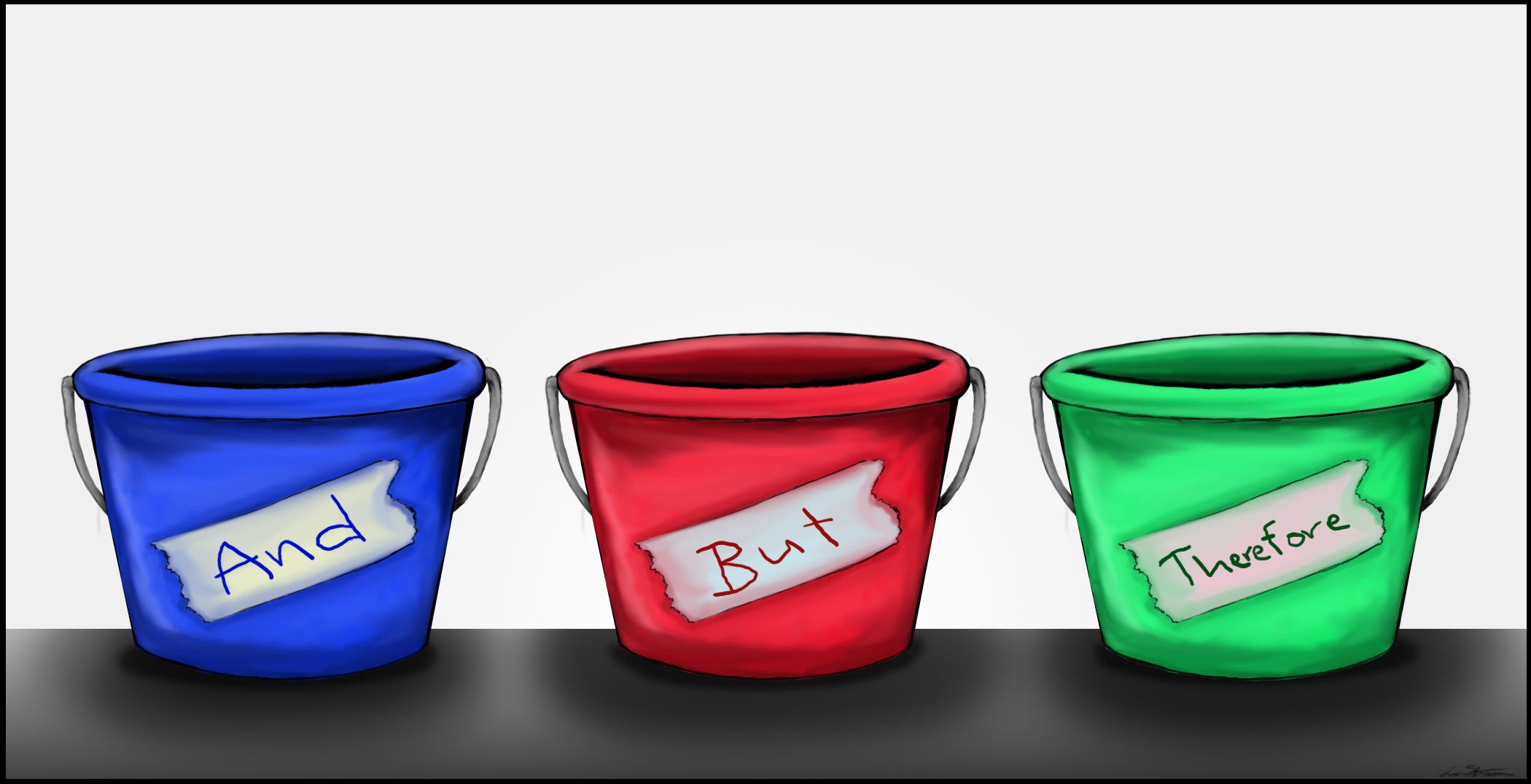
Imagine we have 3 buckets labelled AND, BUT, and THEREFORE. Here’s how we’d sort your pile of information based on the traits the information has:
AND Bucket: Background context and aspirations
BUT Bucket: Problems and obstacles
THEREFORE Bucket: Solutions and conclusions
The reason why sequencing information in this ABT format is so effective at guiding attention is because of the distinct emotional responses each part of the ABT elicits, and how those distinct emotional responses create a pattern and then break the pattern:
AND Bucket: Optimism/hope/comfort - pattern established
BUT Bucket: Frustration/confusion/despair/discomfort - pattern broken & attention heightened
THEREFORE Bucket: Resolve/determination/focus - broken pattern resolved & attention sustained
Ta da! You’ve grabbed and kept your audience’s attention!
But when those emotional traits are mixed, things can go awry.
Consider the following two ABTs:
ABT 1: Green spaces are an essential part of a healthy community AND IF we expand our green spaces THEN studies show the mental well being of our local citizens will increase and projections forecast that local business will benefit from increased tourism BUT we can’t expand our green spaces BECAUSE the system for updating our zoning restrictions is outdated, THEREFORE we are fixing this system BY creating a new policy to update our zoning restrictions.
ABT 2: A lack of green spaces is linked to citizen mental health issues AND zoning restrictions are a road block in creating more green spaces BUT we currently don’t have a policy in place that can fix it THEREFORE we are creating a new policy to update our zoning restrictions.
ABT #2 suffers from what we call “trait contamination,” when traits that should be associated with one part of an ABT end up in the wrong section.
In this case, there’s no longer a clear emotional distinction between the setup (AND) and the problem (BUT). There’s no emotional pattern to break going from the setup to the problem, nothing to focus the audience on in that moment. In short, keeping emotional traits distinct for each section helps with clarity.
How can you fix this type of trait contamination in your AND? Check out my earlier blog post on converting problems into aspirations.